

Fred Swaniker: The Ghanaian Entrepreneur Building Africa’s Next Generation of Leaders

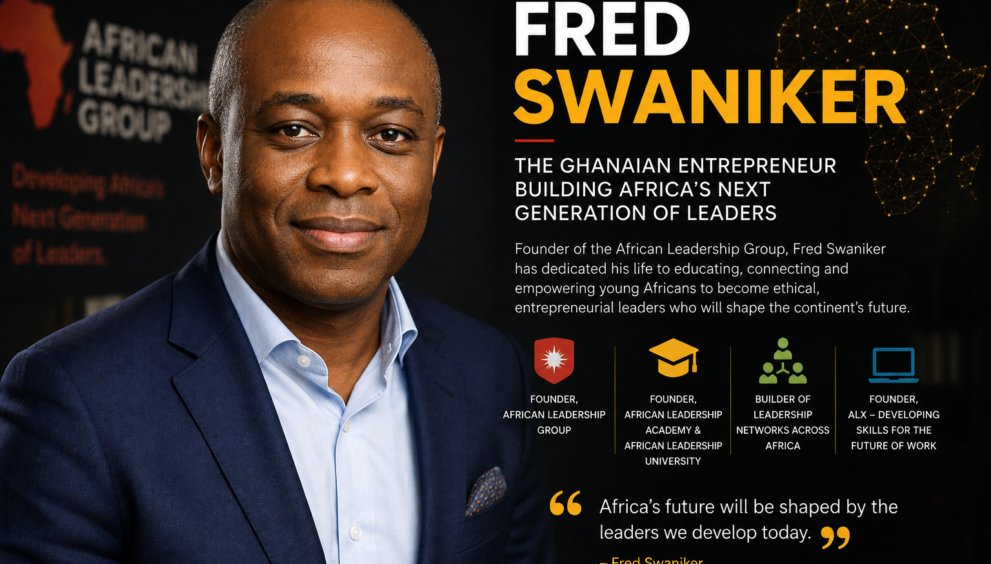
For Swaniker, the answer has never been simply to wait for the next generation to emerge. He believes leadership can be deliberately developed, nurtured and connected across borders. That belief has shaped a career that has moved from education to entrepreneurship, technology, workforce development and institution building.
Born in Ghana and raised across several African countries, Swaniker has built a collection of organizations designed around one central idea: Africa’s greatest resource is its people, and that resource needs to be developed at scale.
His journey began with the African Leadership Academy and later expanded into the African Leadership University, the African Leadership Network and ALX. Together, these initiatives have become part of a much broader African Leadership Group ecosystem focused on developing talent, leadership and economic opportunity across the continent.
Who Is Fred Swaniker?
Fred Swaniker is a Ghanaian entrepreneur, education leader and founder of the African Leadership Group. His work focuses on developing African leaders and creating institutions that give young people the education, skills, networks and opportunities needed to make an impact.
His background is unusually international. Growing up across different African countries gave him an early understanding that the continent is diverse, but that many of its countries face challenges that cross national borders.
He later studied at Macalester College in the United States and earned an MBA from Stanford Graduate School of Business. Before fully committing himself to entrepreneurship, he worked at McKinsey & Company, gaining experience in business strategy and organizational development.
But the conventional corporate path was not where Swaniker’s ambitions ultimately led him.
He wanted to work on a problem that he believed would determine Africa’s future for generations: leadership.
Growing Up Across Africa
Swaniker’s childhood played an important role in shaping his worldview.
He was born in Ghana and lived in several African countries while growing up, including Botswana and Zimbabwe. Moving between different societies exposed him to different political systems, cultures and economic realities.
Instead of developing a narrow view of one country, he began to see Africa as a much larger ecosystem.
The borders were different, the languages and cultures varied, and the economies operated differently. Yet many of the challenges were familiar: limited opportunities for young people, weaknesses in institutions, unemployment and the need for stronger leadership.
That experience eventually influenced his belief that Africa needed leaders who could think beyond individual countries and understand the continent as a connected community.
The Leadership Question
Swaniker’s interest in leadership was not simply about politics.
He saw leadership as something that affects almost every part of society. Businesses need capable leaders. Schools need capable leaders. Governments need capable leaders. Non-profit organizations, hospitals, technology companies and communities all depend on people who can make good decisions and bring others together.
The question, therefore, was not simply where Africa would find its next political leaders.
The bigger question was how Africa could develop millions of capable people who could lead in whatever field they chose.
That thinking became the foundation for his first major entrepreneurial venture.
Building the African Leadership Academy
Swaniker co-founded the African Leadership Academy in Johannesburg, South Africa, with a vision of identifying talented young Africans and giving them an education built around leadership, entrepreneurship and African studies.
The concept was different from a traditional secondary school.
Academic performance mattered, but it was not the only measure of success. Students were encouraged to develop leadership abilities, understand the challenges facing the continent and think about how they could contribute to solving them.
Perhaps most importantly, the Academy brought young people from different parts of Africa into the same environment.
A student from Ghana could form friendships with someone from Kenya. A future entrepreneur from Nigeria could meet a future policymaker from Rwanda. A student interested in science could learn alongside someone passionate about public service.
The relationships created through that experience could potentially last for decades.
Swaniker was not simply building a school.
He was beginning to build a network.
Why Education Became His Entrepreneurial Tool
For Swaniker, education was never meant to be separated from the real world.
A university degree can give someone knowledge, but knowledge alone does not guarantee that a person can create a business, manage an organization or solve a complicated social problem.
That led Swaniker to think differently about what African education should accomplish.
Students needed opportunities to experiment, solve problems, build relationships and develop practical skills alongside their academic studies.
This philosophy would eventually influence the creation of the African Leadership University.
The African Leadership University
The African Leadership University was created as a pan-African institution designed to rethink higher education.
Instead of treating university primarily as a place where students collect academic qualifications, ALU was built around leadership, entrepreneurship, problem solving and practical experience.
The idea was particularly relevant to Africa’s young population.
Every year, millions of young Africans enter the labour market. If education only prepares them to compete for existing jobs, the continent will always struggle to create enough opportunities.
But if education can also teach young people how to create businesses, develop new products, solve problems and build organizations, then education itself becomes part of the economic engine.
That is the kind of transformation Swaniker has pursued.
From Graduates to Problem Solvers
The philosophy behind Swaniker’s education model can be summed up in a simple question: what should a graduate be able to do?
It is easy to measure grades and qualifications.
It is harder to measure whether someone can build a company, lead a team, solve a community problem or create an institution that improves people’s lives.
Swaniker’s approach places greater emphasis on those practical outcomes.
Education should not simply produce people who are qualified to look for opportunities.
It should produce people capable of creating opportunities for themselves and others.
Building a Network of African Leaders
Swaniker also understood that leadership development does not end when someone graduates.
People need networks.
They need mentors, collaborators, investors, advisers and peers who understand the challenges they are trying to solve.
That thinking led to the development of the African Leadership Network, a community connecting influential Africans across business, government, academia, civil society and other fields.
The idea behind the network is powerful: one leader can create change, but connected leaders can potentially create change at a much greater scale.
A business founder may understand markets. A policymaker may understand government. A scientist may understand technology. An investor may understand capital.
When those people connect, opportunities emerge that none of them might have discovered alone.
The Move Into Technology and Workforce Development
As technology transformed the global economy, Swaniker’s work expanded beyond traditional education.
The African Leadership ecosystem increasingly focused on giving young Africans practical skills that could connect them with opportunities in the modern workforce.
This became a major part of the work associated with ALX.
The shift made sense.
Africa does not only need more university graduates. It needs people with skills that businesses actually need.
Technology, data, software development, sales, entrepreneurship and other modern skills can create pathways into employment while also giving young people the ability to build their own ventures.
For Swaniker, leadership development and economic opportunity are closely connected.
Building at African Scale
One of the defining characteristics of Swaniker’s career is his focus on scale.
It would be possible to build an excellent school serving a few hundred students and consider the mission successful.
But Africa is home to more than a billion people.
A solution that reaches only a small number of people cannot solve problems that affect entire generations.
That is why Swaniker has repeatedly looked for ways to take his ideas beyond individual institutions and into larger networks.
The African Leadership Group now brings together initiatives spanning education, leadership development, workforce development and entrepreneurship.
The ambition is no longer simply to educate a few exceptional young Africans.
It is to develop talent at continental scale.
The Three Million Leaders Ambition
The African Leadership Group has articulated an ambitious long-term goal: developing three million ethical and entrepreneurial African leaders.
That number is deliberately large.
Swaniker’s argument is that Africa’s challenges are too significant to be solved by a small group of exceptional individuals.
The continent needs leaders everywhere.
It needs entrepreneurs creating jobs, scientists developing new technologies, doctors improving healthcare, educators strengthening schools, policymakers improving institutions and community leaders solving problems close to home.
Leadership, in this sense, is not restricted to political office.
It is the ability to take responsibility, make decisions and create value for other people.
Why Leadership Is Also an Economic Issue
Leadership is often discussed as a political subject, but Swaniker’s work takes a broader view.
The quality of leadership inside a company can determine whether that company survives.
The quality of leadership inside a government can influence whether businesses can operate effectively.
The quality of leadership inside a school can affect the quality of education an entire generation receives.
Strong leaders can create jobs, attract investment, improve institutions and build organizations that continue creating value long after the founder is gone.
That is why Swaniker treats leadership development as an economic issue as much as an educational one.
The Entrepreneur Behind the Mission
It is easy to describe Swaniker primarily as an educator.
But his career is fundamentally entrepreneurial.
Entrepreneurship is about identifying a problem and building something that does not yet exist to solve it.
That is exactly what Swaniker has done repeatedly.
He saw a leadership gap and built the African Leadership Academy.
He saw limitations in conventional higher education and helped build the African Leadership University.
He saw the need for stronger connections among African leaders and developed the African Leadership Network.
He saw the growing demand for modern skills and expanded into workforce development through ALX.
The individual organizations may be different, but they are connected by the same underlying mission.
Thinking Beyond National Borders
One of Swaniker’s strongest ideas is that African leadership should not be limited by national borders.
A founder in Ghana can build a company that serves customers in Nigeria.
A technology professional in Kenya can work for an international company.
A policymaker in Rwanda can learn from reforms implemented elsewhere on the continent.
An entrepreneur in Senegal can collaborate with a developer in South Africa.
The future of Africa will increasingly depend on those connections.
Swaniker’s institutions have therefore tried to create communities where young Africans can see the continent as a shared space for opportunity rather than simply a collection of separate markets.
Africa’s Young Population
Africa has one of the youngest populations in the world.
That creates enormous potential, but it also creates an enormous responsibility.
Young people need meaningful pathways into adulthood. They need education, skills, employment, entrepreneurship opportunities and institutions that allow them to participate in the economy.
If those opportunities are created, Africa’s young population can become one of its greatest economic advantages.
If they are not, the same demographic trend can create enormous pressure on governments, businesses and communities.
Swaniker’s work is built around the belief that developing people is one of the most effective ways to prepare for that future.
What Entrepreneurs Can Learn From Fred Swaniker
1. Find a Problem That Matters
Swaniker did not build his career around a trend.
He focused on a structural problem that he believed would affect Africa for decades.
Entrepreneurs should not be afraid of large problems. Difficult problems often contain the largest opportunities for meaningful impact.
2. Build for the Long Term
Leadership development does not produce instant results.
A student may enter a leadership programme as a teenager and only become an influential business or public leader decades later.
Swaniker’s work demonstrates the value of building with a long time horizon.
3. Think Beyond One Product
One of Swaniker’s strengths has been his ability to expand an idea into an ecosystem.
A school became a network. A university became part of a broader leadership system. Education expanded into workforce development and entrepreneurship.
Entrepreneurs should always ask whether their first product is actually the beginning of a much bigger opportunity.
4. Build Communities
Customers are important, but communities can be even more powerful.
A strong community can provide partnerships, referrals, mentorship, knowledge and opportunities.
Swaniker has made community-building a central part of his work.
5. Scale What Works
Solving a problem for a small group is valuable.
Building a system that can solve it for hundreds of thousands of people is a completely different challenge.
Swaniker’s career demonstrates the importance of designing organizations with scale in mind when the problem itself exists at continental level.
What Fred Swaniker’s Story Means for Africa
Fred Swaniker’s work raises a question that every African country will eventually have to answer: who will build the institutions of tomorrow?
Natural resources can generate wealth.
Technology can create new industries.
Investment can provide capital.
But none of those things can reach their full potential without people capable of turning resources and ideas into functioning organizations.
That is why Swaniker’s focus on human capital matters.
He is betting that if Africa can develop enough capable, ethical and entrepreneurial people, those individuals will go on to build the businesses, institutions and communities that the continent needs.
It is a long-term bet.
But it is also one of the most important bets Africa can make.
The Bigger Story
Fred Swaniker’s entrepreneurial journey is different from that of the typical business founder.
He did not begin by asking what product he could sell.
He began by asking what Africa needed.
His answer was leadership.
That answer led to a school, then a university, then a network and eventually a broader ecosystem focused on education, skills, entrepreneurship and opportunity.
What makes the journey remarkable is the consistency of the underlying idea.
Swaniker has spent years building systems around African talent.
He has worked to create environments where young Africans can learn from one another, develop practical skills, start companies, enter the workforce and eventually become leaders themselves.
The greatest measure of his success may therefore not be the organizations that carry his fingerprints today.
It may be what the people who passed through those organizations go on to build tomorrow.
That is the long game.
And it is the game Fred Swaniker has chosen to play.
Frequently Asked Questions About Fred Swaniker
Who is Fred Swaniker?
Fred Swaniker is a Ghanaian entrepreneur and education leader best known for founding the African Leadership Group and helping establish institutions focused on developing African leaders.
What is Fred Swaniker known for?
He is known for building the African Leadership Academy, African Leadership University and other initiatives focused on leadership, education, entrepreneurship and workforce development across Africa.
What is the African Leadership Group?
The African Leadership Group is an ecosystem of organizations focused on developing and empowering Africa’s next generation of ethical and entrepreneurial leaders.
What is the African Leadership Academy?
The African Leadership Academy is a pan-African secondary school in South Africa focused on developing young people through academics, leadership development, entrepreneurship and African studies.
What is the African Leadership University?
The African Leadership University is a pan-African university founded around a model that emphasizes leadership, entrepreneurship, practical experience and problem solving.
What is ALX?
ALX is a workforce development initiative within the wider African Leadership ecosystem, focused on helping young Africans develop skills relevant to the modern economy.
What is Fred Swaniker’s vision?
Swaniker’s work is built around developing large numbers of ethical, entrepreneurial African leaders who can create businesses, strengthen institutions and solve problems across the continent.
Conclusion
Fred Swaniker’s story is ultimately about people.
Not one person.
Not one company.
But millions of young Africans who have the potential to shape what the continent becomes next.
His career has been built around the belief that leadership can be developed deliberately and that Africa should invest in its own talent at scale.
From the African Leadership Academy to the African Leadership University and the wider African Leadership Group ecosystem, Swaniker has spent years turning that belief into institutions.
His greatest contribution may therefore not be a single organization or achievement.
It may be the generation of Africans who go through these institutions and eventually build companies, governments, technologies and communities of their own.
Because sometimes the most important thing an entrepreneur can build is not the business itself, but the people who will build what comes next.

Patrice Motsepe: The Builder Who Changed African Mining | GINAGIDA
01st Sep 2026[…] Fred Swaniker: The Ghanaian Entrepreneur Building Africa’s Next Generation of Leaders […]