




Bethlehem Tilahun Alemu: The Ethiopian Entrepreneur Who Turned Local Craftsmanship Into a Global Brand

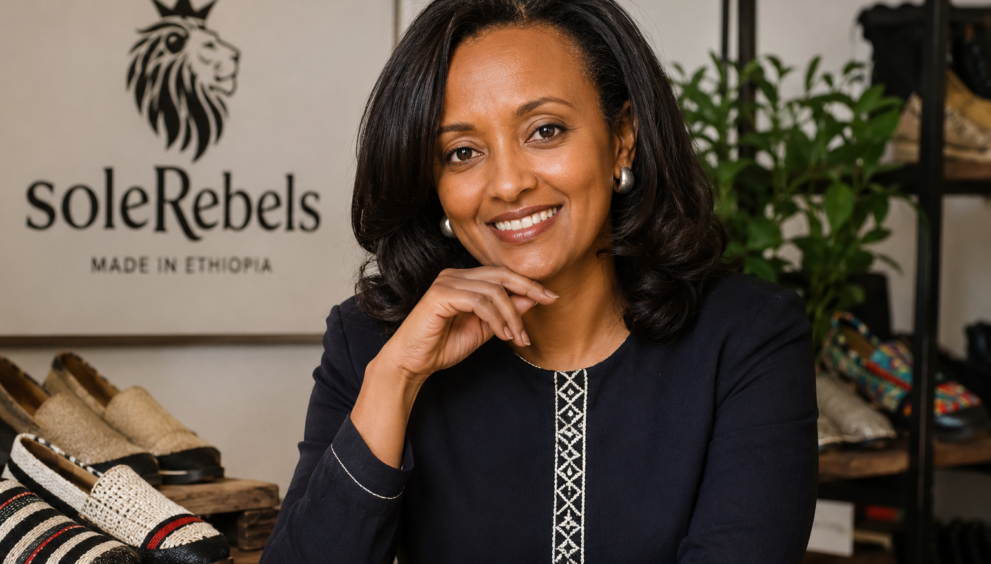
That ambition became soleRebels, the Ethiopian footwear company she founded in Addis Ababa. What started with a small workshop and a community of artisans eventually became an internationally recognized African brand, putting Ethiopian craftsmanship, recycled materials and contemporary design in front of customers around the world.
But the story of Bethlehem Tilahun Alemu is bigger than shoes.
It is a story about entrepreneurship, African manufacturing, women in business, job creation and the power of building global businesses from local resources.
At a time when much of the conversation about Africa was still dominated by poverty and aid, Alemu offered a different proposition: Africa could create products, build brands and compete in global markets on its own terms.
Who Is Bethlehem Tilahun Alemu?
Bethlehem Tilahun Alemu is an Ethiopian entrepreneur and the founder of soleRebels, a footwear brand built around Ethiopian craftsmanship, sustainable materials and locally rooted production.
She was born and raised in the Zenebework area of Addis Ababa, an economically disadvantaged community where she saw firsthand how limited employment opportunities affected families around her.
Rather than viewing the community only through the challenges it faced, Alemu noticed something else: there was talent everywhere.
Local artisans possessed skills that had been passed down through generations. They knew how to work with leather, natural fibres and other materials. Ethiopia also had a long tradition of handmade footwear and craft production.
The challenge was turning those skills into sustainable economic opportunity.
That became the foundation of Alemu’s entrepreneurial journey.
The Idea That Started soleRebels
The origins of soleRebels can be traced to Alemu’s desire to create jobs in her community while building something that could reach customers beyond Ethiopia.
She did not want to create a business that simply sold Ethiopian products locally.
She wanted to build a genuine global brand.
The idea was straightforward but ambitious: take traditional Ethiopian craftsmanship, combine it with modern design and create products that people anywhere in the world would want to buy.
The footwear industry became the vehicle for that idea.
Alemu drew inspiration from traditional Ethiopian footwear known as the selate and barabasso, including shoes made with recycled tyre soles. Instead of treating that tradition as something old-fashioned, she saw an opportunity to reinterpret it for a modern audience.
That approach would become one of soleRebels’ defining characteristics.
Starting With a Small Workshop
In the beginning, the business was anything but glamorous.
Alemu started with a small workshop in her community, working alongside local artisans and using resources that were available around them.
The business was built from the ground up.
There was no multinational manufacturing network waiting to produce the shoes. There was no massive advertising budget capable of introducing the brand to the world overnight.
Instead, there were artisans, ideas, locally available materials and a founder who believed the product could travel.
That is an important part of Alemu’s story.
She did not wait until Ethiopia had all the infrastructure of a major global manufacturing hub before starting.
She started with what was available and built from there.
Turning Ethiopian Craftsmanship Into a Brand
One of Alemu’s most important decisions was understanding that craftsmanship alone would not be enough.
A product can be beautifully made and still fail commercially.
To compete internationally, it also needs design, branding, consistency, distribution and a story that customers can understand.
That is where soleRebels became particularly interesting.
The company did not simply sell handmade Ethiopian shoes.
It created a recognizable identity around African craftsmanship and contemporary footwear.
The traditional elements became part of the brand rather than something hidden from customers.
Materials, techniques and cultural influences were incorporated into products designed for a modern international market.
The message was clear: African heritage was not a limitation.
It could be an advantage.
Why the Name soleRebels Matters
The name soleRebels carries a connection to Ethiopian history and traditional footwear.
The company drew inspiration from Ethiopian shoes made with recycled rubber tyres, a practical tradition that had existed long before sustainability became a major global business trend.
That history helped give the brand an identity that was distinctly Ethiopian while still being easy for international customers to understand.
It was rebellious in another sense too.
Alemu was challenging the assumption that global consumer brands had to come primarily from Europe, North America or other established industrial markets.
She was building a brand from Addis Ababa and asking the global market to pay attention.
Building a Business Around Local Talent
For Alemu, creating products was only one part of the mission.
Creating jobs was equally important.
The business was deliberately designed around the skills of people in the local community.
Instead of replacing traditional craftsmanship with industrial production, soleRebels built its model around artisans and handmade production.
That created an important connection between business growth and local economic opportunity.
As the company grew, more people could participate in the production process and earn a livelihood from skills they already possessed.
This became one of the most powerful elements of Alemu’s business philosophy: economic development does not always have to begin by importing everything from outside.
Sometimes it begins by recognizing the value that already exists within a community.
From Addis Ababa to the Global Market
Building a product is one challenge.
Convincing the world to buy it is another.
Alemu understood early that soleRebels needed to operate beyond Ethiopia if it was going to become the kind of company she imagined.
The company therefore embraced international distribution and e-commerce as part of its growth strategy.
This was especially important because digital commerce gave an African brand the ability to reach customers without relying entirely on traditional retail infrastructure.
A customer sitting thousands of kilometres away could discover the brand, learn about its story and purchase its products.
That changed the equation.
An entrepreneur in Addis Ababa could now build a brand for a global audience without first needing to establish physical stores in every major city.
The Power of E-Commerce
Alemu was an early believer in the potential of e-commerce for African businesses.
For a company operating from Ethiopia, the internet offered something extremely valuable: access.
Access to customers.
Access to global markets.
Access to a much larger audience than a local storefront could provide.
soleRebels used online channels and international retail partnerships to introduce its products to customers outside Ethiopia.
That strategy demonstrated an important lesson for African entrepreneurs.
You do not necessarily need to physically move your company to London, New York or Paris to build a global brand.
With the right product, positioning and technology, the global market can be approached from home.
A Different Story About Africa
Perhaps Alemu’s greatest contribution goes beyond the footwear industry.
She helped tell a different story about Africa.
For decades, international coverage of the continent often focused heavily on conflict, poverty, humanitarian crises and political instability.
Those realities exist, but they are not the whole story.
Alemu’s company offered another image.
An African company could manufacture.
African artisans could produce premium goods.
An Ethiopian entrepreneur could build an international consumer brand.
Local materials could become export products.
And African creativity could have commercial value in global markets.
That shift in narrative matters because perceptions influence investment, partnerships, tourism, consumer behaviour and how Africans see their own possibilities.
Why Sustainability Became Part of the Business
Long before sustainability became one of the biggest themes in global fashion, soleRebels was drawing on traditional production methods and recycled materials.
Recycled tyre soles became a recognizable part of the brand’s identity.
The company also incorporated natural and locally sourced fibres into its products.
For Alemu, sustainability was not simply a marketing phrase.
It was connected to the resources and traditions available in Ethiopia.
Traditional African craftsmanship often developed around making the most of what communities had.
Materials were reused.
Products were repaired.
Craft techniques were passed from one generation to another.
By combining those traditions with contemporary design, Alemu demonstrated how heritage and modern business could work together.
The Woman Behind the Brand
Bethlehem Tilahun Alemu also became an important figure in the story of African women in entrepreneurship.
Her career challenged more than one stereotype.
She was building a manufacturing company in Ethiopia. She was entering an international consumer market. She was creating a brand in an industry dominated by much larger global players.
And she was doing it as an African woman entrepreneur.
Her achievements brought international recognition, including recognition from organizations and publications such as Forbes and the World Economic Forum.
But perhaps the more important part of her story is what her example communicates to other women.
Entrepreneurship does not have to mean choosing between social impact and commercial ambition.
A company can create jobs while pursuing international growth.
A business can celebrate culture while competing on quality.
A woman can build a company that reaches markets far beyond her home country.
Recognition on the Global Stage
Alemu’s work eventually attracted significant international attention.
She was recognized by Forbes as one of Africa’s prominent young women in business and was also recognized by the World Economic Forum community.
In 2012, she received the Schwab Foundation’s Social Entrepreneur of the Year award at the World Economic Forum on Africa.
These recognitions were important, but they were not what created the business.
The company had already been built around a practical idea: create jobs, use local skills and make products that customers around the world would value.
The recognition simply brought a wider audience to the story.
Beyond soleRebels
Alemu’s entrepreneurial ambitions have not been limited to footwear.
Her broader business interests have included ventures connected to Ethiopian coffee and food, reflecting the same underlying philosophy that shaped soleRebels.
That philosophy is built around taking something Ethiopia already has and developing it into a product with wider commercial potential.
Coffee is a particularly powerful example.
Ethiopia is widely recognized as the birthplace of coffee and has an extraordinary coffee culture and heritage.
The opportunity is not simply to export raw agricultural products.
There is also an opportunity to build brands, experiences and consumer products around that heritage.
That is the kind of value creation that Alemu has consistently pursued.
The African Brand Opportunity
One of the biggest lessons from Alemu’s career is that Africa does not have to remain primarily a supplier of raw materials.
The continent can move further up the value chain.
Instead of exporting cotton, companies can create clothing.
Instead of exporting leather, businesses can create finished leather goods.
Instead of exporting coffee beans, entrepreneurs can build coffee brands.
Instead of exporting natural fibres, companies can create finished consumer products.
The difference is value.
When more of the production, branding and distribution happens locally, more economic value can potentially remain within the country and the continent.
Alemu’s career provides a practical example of what that approach can look like.
What Entrepreneurs Can Learn From Bethlehem Tilahun Alemu
1. Start With What You Have
Alemu did not begin with the resources of a multinational corporation.
She began with local artisans, traditional skills, available materials and a clear business idea.
Entrepreneurs often spend too much time thinking about what they lack.
A better question can be: what do I already have that can be turned into value?
2. Local Does Not Mean Small
One of the strongest lessons from soleRebels is that a business can be deeply rooted in one community while serving customers around the world.
Being local can actually become part of the competitive advantage.
Authenticity, craftsmanship and cultural identity can differentiate a product in a crowded international market.
3. Build a Brand, Not Just a Product
A pair of shoes is a product.
soleRebels became a brand.
The difference matters.
A brand gives customers a reason to remember a company, talk about it and identify with what it represents.
Alemu understood that Ethiopian heritage could become part of the company’s identity rather than something hidden behind the product.
4. Turn Challenges Into Advantages
Limited access to conventional manufacturing infrastructure could have been treated only as a disadvantage.
Instead, Alemu built around artisan production and local materials.
The challenge became part of the company’s story.
That is an important entrepreneurial mindset: sometimes the thing that makes your business different is also the thing that makes it valuable.
5. Think Globally From the Beginning
Alemu did not build soleRebels with the assumption that Ethiopian customers would be the only market.
She wanted the brand to compete internationally.
For today’s African entrepreneur, that mindset is even more relevant because digital platforms make international discovery easier than ever.
6. Create Economic Value Around Culture
African culture is rich with art, music, food, fashion, crafts, stories and traditions.
But culture becomes even more powerful economically when entrepreneurs build sustainable businesses around it.
Alemu demonstrated that heritage can become an asset in the global marketplace.
What Her Story Means for African Women
For African women considering entrepreneurship, Alemu’s journey offers something more valuable than inspiration alone.
It offers a business model.
Identify a problem.
Understand the resources around you.
Find talented people.
Create something customers genuinely want.
Build a strong brand.
Then take it beyond your immediate market.
That formula is not limited to footwear.
It can apply to agriculture, technology, fashion, food, manufacturing, media, tourism and almost every other sector where Africa has talent and resources.
The Bigger Lesson for Africa
Bethlehem Tilahun Alemu’s story matters because it challenges a familiar question.
Instead of asking what Africa needs to import, what if more entrepreneurs asked what Africa can build?
What if local artisans became part of global supply chains?
What if African designers created international fashion brands?
What if African manufacturers produced products that were sold around the world?
What if African companies were judged primarily by the quality of what they produced rather than by assumptions about where they came from?
Those questions sit at the heart of Alemu’s entrepreneurial journey.
She showed that a company can start in a neighbourhood in Addis Ababa and still have global ambitions.
Why Bethlehem Tilahun Alemu’s Story Still Matters
Entrepreneurship is often presented as a story about money, growth and success.
Alemu’s story presents a broader definition.
Success can also mean creating opportunities for people who previously had few.
It can mean preserving valuable traditions while giving them a modern commercial purpose.
It can mean taking local resources and creating products with international appeal.
And it can mean changing how people think about what is possible.
That last point may be the most important.
When one African entrepreneur builds a global company, the immediate impact is measured in jobs, products and revenue.
But the example can have a second effect.
It can make another entrepreneur believe that they can do it too.
Conclusion
Bethlehem Tilahun Alemu’s journey from Addis Ababa to the global marketplace is a powerful example of what happens when entrepreneurship begins with confidence in local talent.
She saw skilled people where others might have seen unemployment.
She saw traditional craftsmanship where others might have seen old-fashioned production.
She saw recycled materials where others might have seen waste.
And she saw the possibility of a global African brand where many people were still looking outside the continent for examples of world-class businesses.
Through soleRebels, Alemu built more than a footwear company. She built a case for African creativity, local manufacturing and women-led entrepreneurship.
Her story is a reminder that global businesses do not always begin in global cities.
Sometimes they begin in a small workshop, with a few determined people, a useful idea and the courage to believe that the world is ready for what they can create.
Bethlehem Tilahun Alemu did not wait for the world to discover Ethiopia. She built something that gave the world a reason to look.
Frequently Asked Questions About Bethlehem Tilahun Alemu
Who is Bethlehem Tilahun Alemu?
Bethlehem Tilahun Alemu is an Ethiopian entrepreneur best known as the founder of soleRebels, a footwear company built around Ethiopian craftsmanship, sustainable materials and local production.
What company did Bethlehem Tilahun Alemu found?
She founded soleRebels, an Ethiopian footwear brand that combines traditional craftsmanship with contemporary footwear design.
When did Bethlehem Tilahun Alemu start soleRebels?
The idea for soleRebels began in 2004, with the company developing into a formal footwear business in the following period.
What makes soleRebels different?
soleRebels is known for combining Ethiopian artisan craftsmanship, traditional footwear influences, recycled materials and contemporary designs while maintaining a strong focus on local production.
Why is Bethlehem Tilahun Alemu important to African entrepreneurship?
Her career demonstrates how African entrepreneurs can use local skills, resources and cultural heritage to create businesses capable of reaching international markets.
What can entrepreneurs learn from Bethlehem Tilahun Alemu?
Her story highlights the importance of starting with available resources, building a strong brand, valuing local talent, thinking globally and turning cultural heritage into economic opportunity.
Final Word
For GINAGIDA, Bethlehem Tilahun Alemu represents the kind of African entrepreneur whose story deserves to be told beyond the headlines.
She is part of a generation proving that Africa is not only a market for global brands.
Africa can build them too.