
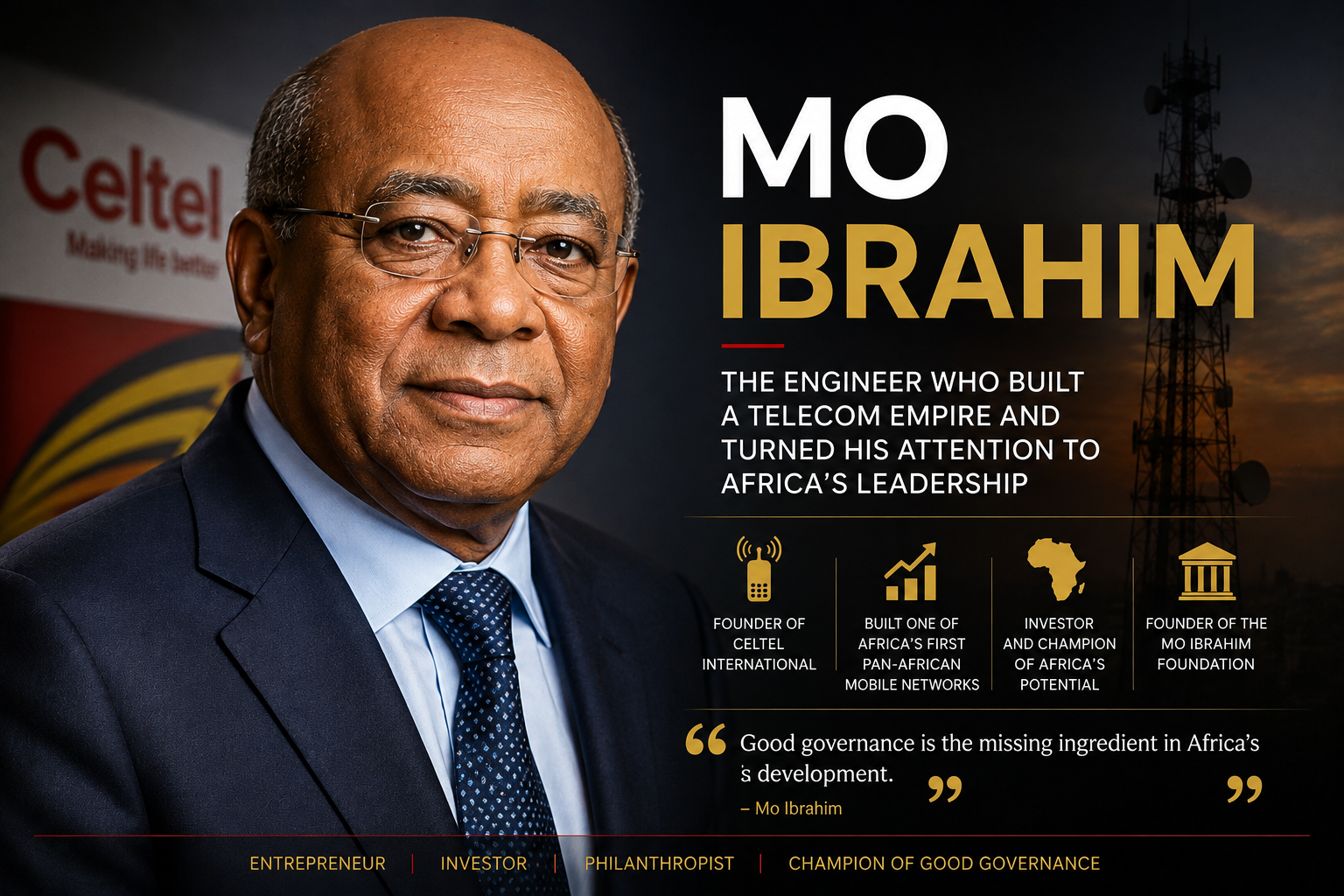

Mo Ibrahim: The Engineer Who Built a Telecom Empire and Turned His Attention to Africa’s Leadership
By GINAGIDA Editorial
There was a time when making a mobile phone call across much of Africa was neither simple nor affordable. Telecommunications infrastructure was limited, national markets were fragmented, and millions of people remained disconnected from one another. Into that environment came Mo Ibrahim, a Sudanese-born telecommunications engineer who saw something others were only beginning to notice: Africa’s lack of connectivity was not only a challenge, but one of the continent’s biggest opportunities.
In 1998, Ibrahim founded Celtel International, a company that would become one of Africa’s pioneering mobile telecommunications businesses. The company expanded across the continent, helping bring mobile connectivity to markets that had long been underserved. When Celtel was eventually sold in 2005 for $3.4 billion, Ibrahim had achieved what few African entrepreneurs had done before him: he had built a genuinely pan-African technology business of enormous scale.
But the sale of Celtel did not mark the end of his African story. It opened the door to another chapter. In 2006, Ibrahim established the Mo Ibrahim Foundation, turning his attention from telecommunications to leadership, governance and the institutions that shape Africa’s future.
That transition is what makes his story particularly compelling. Mo Ibrahim did not simply build a successful company and walk away. He moved from building communication networks to asking a much bigger question: what kind of leadership and institutions does Africa need to turn its potential into lasting progress?
From Sudan to Telecommunications
Mohammed Ibrahim was born in Sudan and developed an early interest in engineering and communications. He studied electrical engineering at the University of Alexandria in Egypt before continuing his education in the United Kingdom, where he earned a PhD in mobile communications from the University of Birmingham.
His technical background would become one of the defining advantages of his career. Ibrahim was not approaching telecommunications simply as an investor looking for the next profitable industry. He understood the technology itself, the networks behind it and the practical challenges involved in connecting people across large and complex markets.
He began his professional career in the telecommunications industry and later worked with British Telecom, where he gained extensive experience in mobile communications. He eventually became Technical Director of Cellnet, a BT mobile communications business. Those years gave him a front-row view of an industry that was beginning to transform how people communicated around the world.
For Ibrahim, the question was not whether mobile telecommunications would change society. It was whether Africa would be able to participate fully in that transformation.
Building Mobile Systems International
Before Celtel, Ibrahim had already established himself as an entrepreneur. In 1989, he founded Mobile Systems International, a telecommunications consultancy and software company that provided expertise to mobile operators around the world.
The company gave Ibrahim valuable experience in the rapidly developing cellular communications industry. More importantly, it placed him in a position to understand the enormous commercial and social potential of mobile technology in emerging markets.
By the late 1990s, mobile telecommunications was expanding rapidly across developed economies. Africa, however, remained significantly underserved. Fixed telephone infrastructure was expensive to build and difficult to expand across many countries. Mobile technology offered a different possibility: leapfrogging traditional infrastructure and connecting communities without having to reproduce every stage of the telecommunications systems that developed economies had built over decades.
Ibrahim believed Africa was ready for that opportunity.
The Celtel Bet
In 1998, Ibrahim founded Celtel International. The ambition was straightforward but enormous: build mobile telecommunications networks across African markets where reliable connectivity remained limited.
It was not an easy proposition. Operating across Africa meant dealing with different governments, regulatory systems, currencies, infrastructure conditions and consumer markets. A company trying to expand across several countries had to understand far more than telecommunications technology. It had to understand the political and economic realities of each market.
Ibrahim’s technical knowledge, combined with his understanding of African markets, helped Celtel grow into one of the continent’s most important mobile operators. The company eventually operated across numerous African countries and invested heavily in expanding telecommunications infrastructure.
The significance of Celtel went beyond its financial performance. Mobile phones changed how people communicated, how businesses reached customers and how information moved across borders. For many Africans, mobile connectivity became a gateway to economic opportunity, financial services and participation in increasingly connected markets.
Why Celtel Mattered
It is easy to look at Celtel simply as a successful telecommunications company. Its wider significance, however, was much larger.
A reliable mobile connection can be a business tool. A small trader can communicate with customers and suppliers. A farmer can access information about markets. Families separated by distance can remain connected. Entrepreneurs can reach customers beyond their immediate communities. As mobile technology developed, connectivity also became the foundation for new financial services and digital businesses.
Celtel was part of that transformation. Its growth demonstrated that African markets were capable of supporting large-scale technology businesses and that investment in infrastructure could create both commercial value and wider economic opportunity.
The $3.4 Billion Exit
In 2005, Celtel was sold to Kuwait’s Mobile Telecommunications Company for $3.4 billion. The transaction transformed Ibrahim’s personal financial position and marked one of the most significant exits by an African entrepreneur of his generation.
For many founders, an exit of that size would have been the natural end of the journey. Ibrahim chose to look at it differently. The sale gave him financial independence, but it also gave him the freedom to decide what problem he wanted to work on next.
His next challenge would have little to do with mobile networks.
It would be about leadership.
From Telecoms to Governance
In 2006, Ibrahim established the Mo Ibrahim Foundation, an organization dedicated to improving leadership and governance in Africa. The move represented a significant shift in his career, but there was also a clear connection between the two chapters.
His telecommunications career had shown him the importance of infrastructure. His work after Celtel increasingly focused on another kind of infrastructure: the institutions, systems and leadership needed for societies to function effectively.
The Foundation works to promote better leadership and governance across Africa through research, data, leadership initiatives and programmes designed to support the continent’s next generation of leaders.
For Ibrahim, economic progress cannot be separated from the quality of the institutions that govern societies. Businesses can create jobs and wealth, but strong institutions are needed to create the environment in which those businesses can grow sustainably.
The Ibrahim Index of African Governance
One of the Foundation’s most influential initiatives is the Ibrahim Index of African Governance, widely known as the IIAG.
The index provides data and analysis on governance performance across African countries. It examines areas such as security, rule of law, participation, human rights, economic opportunity and human development.
The importance of this approach is simple. Conversations about governance can easily become political arguments based on competing opinions. Data does not eliminate disagreement, but it gives policymakers, researchers, journalists and citizens a stronger basis for examining what is actually happening.
The Foundation’s work has increasingly emphasized the importance of measuring Africa’s progress honestly rather than relying solely on broad narratives about the continent’s potential.
That approach reflects something Ibrahim has carried throughout his career: the belief that difficult problems become easier to confront when they can be understood clearly.
The Ibrahim Prize and the Question of Leadership
The Mo Ibrahim Foundation also established the Ibrahim Prize for Achievement in African Leadership, which recognizes former African heads of state or government who have demonstrated exceptional leadership and left office in accordance with constitutional limits.
The prize is deliberately different from the usual celebration of political power. It focuses on what leaders accomplish while in office and whether they leave a legacy of responsible leadership and institutional development.
Perhaps most importantly, the prize is not automatically awarded every year. There have been years in which the independent prize committee concluded that no candidate met the required standard.
That decision sends an important message: holding political office is not, by itself, evidence of successful leadership.
The standard should be higher.
Strive Masiyiwa: The Entrepreneur Who Fought to Connect Africa
Investing in Africa
Ibrahim’s work has also continued through investment. He is the Founding Chairman of Satya Capital, an investment firm focused primarily on Africa.
This part of his career reflects another consistent theme: his interest in African businesses and the opportunities created by the continent’s economic transformation.
After building one of Africa’s most recognizable telecommunications companies, Ibrahim could have focused entirely on managing his wealth. Instead, he continued to participate in conversations about investment, entrepreneurship and Africa’s economic future.
Building the Next Generation
One of the most important aspects of Ibrahim’s work today is his focus on developing future African leaders.
The Mo Ibrahim Foundation established its Leadership Fellowship programme to give promising African professionals an opportunity to gain experience within major African and international institutions. The programme is designed not simply to provide professional experience, but to expose emerging leaders to the systems and decisions that influence development across the continent.
The Foundation also supports initiatives focused on African youth and leadership. That focus is particularly relevant to a continent where a large proportion of the population is young and where today’s decisions will shape the opportunities available to future generations.
Ibrahim’s work therefore extends beyond recognizing the leaders Africa has already produced. It is increasingly about helping create the conditions in which the next generation can lead.
A Different Definition of Entrepreneurship
Mo Ibrahim’s career raises an interesting question: when does an entrepreneur stop being an entrepreneur?
Is it when a company is sold? When an entrepreneur becomes an investor? When they establish a foundation? Or when they stop building businesses and start working on systems that affect entire societies?
Ibrahim’s career suggests there may not be a clear boundary.
His entrepreneurial mindset appears to have moved from one major problem to another. He saw a telecommunications gap and built a company around it. Later, he saw challenges around governance and leadership and built institutions designed to help address them.
The tools changed, but the underlying instinct remained the same: identify a significant problem, understand it deeply and build something capable of addressing it.
Lessons Entrepreneurs Can Take From Mo Ibrahim
1. Deep Knowledge Creates Opportunity
Ibrahim’s technical background gave him an advantage when he entered telecommunications. He understood the industry from the inside, which helped him recognize opportunities that others might have overlooked.
For entrepreneurs, the lesson is straightforward: knowing your industry deeply can be just as valuable as having access to capital.
2. Build Around a Real Problem
Celtel was built around a genuine infrastructure gap. Millions of people needed better communication services, while businesses needed reliable ways to connect with customers and markets.
The strongest businesses often begin by solving a problem that already exists at scale.
3. Success Does Not Have to Be the End
The sale of Celtel could have marked the final chapter of Ibrahim’s entrepreneurial career. Instead, it gave him the freedom to pursue a different mission.
Financial success can provide security, but it can also provide something equally valuable: the freedom to choose which problems deserve your attention next.
4. Institutions Matter
A successful company can transform an industry, but strong institutions can influence an entire society.
Through the Mo Ibrahim Foundation, Ibrahim has invested in data, research, leadership development and platforms designed to strengthen governance across Africa.
5. Think Beyond Your Own Generation
One of the strongest themes in Ibrahim’s work is his investment in future African leaders. His programmes for young professionals and emerging leaders reflect the idea that lasting progress requires more than successful individuals. It requires people capable of carrying important institutions forward.
What Mo Ibrahim’s Story Means for Africa
Mo Ibrahim’s story begins with technology, but it does not end there.
He was an engineer who understood telecommunications. He became an entrepreneur who built one of Africa’s pioneering mobile companies. He became an investor who continued backing African opportunities. And eventually, he became an advocate for stronger leadership and governance.
Each stage of his career grew out of the previous one.
Telecommunications taught him about infrastructure. Entrepreneurship gave him the resources and independence to pursue bigger questions. His experience building across African markets gave him a deeper appreciation of the institutions that influence whether businesses and societies can thrive.
That makes his story bigger than the success of Celtel.
It is a story about what happens when an entrepreneur decides that building a company is only one way to create impact.
The Bigger Story
There is a temptation to measure African entrepreneurs only by the companies they build or the wealth they accumulate. Mo Ibrahim’s career offers another way to think about success.
Yes, he built a major telecommunications company. Yes, he achieved a multibillion-dollar exit. But his work after Celtel suggests that his ambitions were never limited to business.
He moved from connecting people through mobile networks to examining how African countries are governed. He created platforms for measuring leadership, supported programmes for emerging leaders and continued to invest in Africa’s economic future.
In that sense, Mo Ibrahim has spent much of his career building infrastructure.
First, it was telecommunications infrastructure.
Later, it became institutional and intellectual infrastructure.
And perhaps that is the most interesting lesson from his journey: sometimes the most important thing an entrepreneur builds is not a company that carries their name, but an institution that continues creating value after they are gone.
For GINAGIDA, that is what makes Mo Ibrahim’s story worth telling.
He did not simply build a business. He kept looking for something bigger to build.
Frequently Asked Questions About Mo Ibrahim
Who is Mo Ibrahim?
Mo Ibrahim is a Sudanese-born telecommunications entrepreneur, investor and philanthropist. He founded Mobile Systems International and Celtel International before establishing the Mo Ibrahim Foundation.
What is Mo Ibrahim famous for?
He is best known for founding Celtel, one of Africa’s pioneering mobile telecommunications companies, and for establishing the Mo Ibrahim Foundation, which focuses on leadership and governance across Africa.
What happened to Celtel?
Celtel was founded by Mo Ibrahim in 1998 and grew into a major African mobile telecommunications company. In 2005, it was sold to Kuwait’s Mobile Telecommunications Company for $3.4 billion.
What is the Mo Ibrahim Foundation?
The Mo Ibrahim Foundation was established in 2006 to support better leadership and governance in Africa. Its work includes governance data, leadership initiatives, fellowships, research and programmes focused on Africa’s future.
What is the Ibrahim Index of African Governance?
The Ibrahim Index of African Governance is a comprehensive data-based framework that assesses governance performance and trends across African countries.
What is the Ibrahim Leadership Fellowship?
The Ibrahim Leadership Fellowship is a programme designed to give emerging African leaders professional experience within major African and international institutions while helping develop the next generation of leadership talent.
Conclusion
Mo Ibrahim’s journey is a reminder that entrepreneurship does not have to end when a company is sold.
For him, selling Celtel created the opportunity to pursue a different kind of ambition: helping Africa think more seriously about leadership, governance, institutions and the people who will shape its future.
From telecommunications engineer to entrepreneur, investor and institution builder, his career has followed a consistent principle—find a problem that matters and build something capable of making a difference.
That is the kind of ambition GINAGIDA exists to document.
These are the people who build Africa.