
Strive Masiyiwa: The Entrepreneur Who Fought to Connect Africa

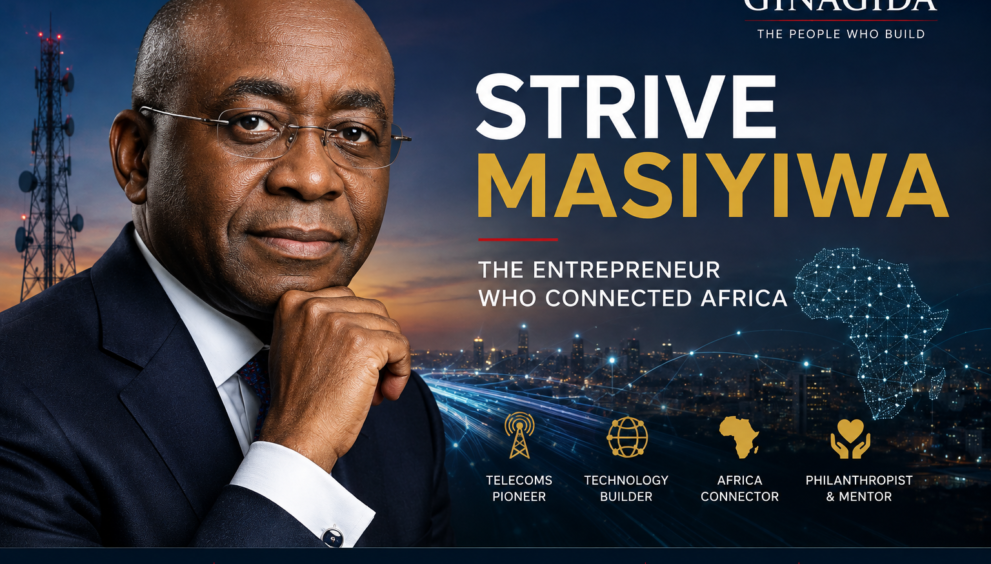
Strive Masiyiwa: The Entrepreneur Who Fought to Connect Africa
Before Africa’s mobile revolution, owning a private telecommunications company in Zimbabwe was not simply a matter of raising money, hiring engineers and building a network.
The government controlled the sector.
Strive Masiyiwa challenged that system.
The Zimbabwean entrepreneur spent five years fighting a legal battle over his right to establish a private telecommunications network. In 1997, Zimbabwe’s High Court ruled in his favour, clearing the way for Econet Wireless to operate. The following year, Econet launched its mobile network.
That victory became the foundation of one of Africa’s most remarkable technology stories.
Masiyiwa went on to build businesses spanning telecommunications, fibre networks, cloud computing, data centres, fintech and artificial intelligence.
His companies have helped connect millions of people and businesses across Africa, while his investments and philanthropic work have extended well beyond telecommunications.
Today, Masiyiwa is the founder and executive chairman of Cassava Technologies and founder and chairman of the Econet Group. Forbes estimated his net worth at about $2.2 billion in August 2026.
But the most interesting part of his story is not the billionaire label.
It is the decision he made decades ago to fight for something that did not yet exist.
Who Is Strive Masiyiwa?
Strive Masiyiwa is a Zimbabwean telecommunications and technology entrepreneur, investor and philanthropist.
Over nearly four decades, he has founded and invested in businesses across Africa and international markets, with interests ranging from mobile telecommunications and fibre infrastructure to cloud computing, data centres, fintech and artificial intelligence.
He is the founder and executive chairman of Cassava Technologies, a technology group whose businesses include Liquid Intelligent Technologies, Africa Data Centres, Cassava AI, Sasai Fintech and Liquid C2.
He is also the founder and chairman of Econet, which describes itself as a technology-focused group built around businesses serving African consumers and enterprises.
Econet currently operates across 23 African markets through its telecommunications, digital technology and social-enterprise businesses.
His influence also extends into philanthropy.
Together with his wife, Tsitsi Masiyiwa, he co-founded Higherlife Foundation in 1996, initially in response to the HIV/AIDS crisis in Zimbabwe. The foundation now works across education, healthcare, livelihoods and community development.
Early Life and Education
Strive Masiyiwa was born in Zimbabwe in 1961.
He left the country as a child and later returned after Zimbabwe gained independence in 1980. According to Econet, he returned in 1984 and briefly worked as a telecommunications engineer before starting his first business in 1986.
His technical background would prove important.
Masiyiwa studied electrical and electronic engineering at what is now Cardiff University in Wales.
That combination — engineering and entrepreneurship — would become a defining feature of his career.
He was not approaching telecommunications simply as a businessman looking for a profitable market.
He understood the technology.
And he could see what that technology could eventually make possible.
The Fight That Changed Everything
Masiyiwa’s most important business battle began with an idea that seems obvious today:
Zimbabweans should be able to access privately operated telecommunications services.
At the time, that was not the reality.
The state maintained a monopoly over the country’s telecommunications sector.
Masiyiwa challenged it.
The legal battle lasted five years.
In 1997, the High Court ruled that Econet had the right to operate its own telecommunications network. Econet describes the decision as one of the milestones that opened Zimbabwe’s telecommunications sector to private capital.
It was a crucial victory.
But winning the court case was only the beginning.
Now Masiyiwa had to build the network.
Building Econet
Econet launched its mobile network in Zimbabwe on July 10, 1998.
The company subsequently became one of the country’s most important telecommunications businesses and listed on the Zimbabwe Stock Exchange later that year.
What Masiyiwa had fought for in court was becoming a physical reality.
Mobile towers.
Customers.
Networks.
Phones.
Connections.
The business expanded beyond Zimbabwe.
Econet’s history includes mobile operations and investments across several African markets, as well as international ventures.
The central idea was straightforward:
Africa needed connectivity, and connectivity would become infrastructure.
Masiyiwa was betting on that future before it was obvious to everyone else.
From Mobile Phones to Digital Infrastructure
The most important evolution in Masiyiwa’s career is that he did not stop at mobile telecommunications.
As Africa’s digital economy grew, the infrastructure underneath it became increasingly important.
People needed more than a mobile signal.
They needed fibre.
They needed data centres.
They needed cloud computing.
They needed cybersecurity.
They needed digital payment systems.
And increasingly, they needed access to computing power for artificial intelligence.
Masiyiwa moved into those layers of the technology ecosystem.
That evolution eventually helped create Cassava Technologies.
Cassava Technologies
Cassava Technologies grew out of the wider Econet ecosystem and was established as a technology group focused on digital infrastructure and services.
Today, its businesses include:
- Liquid Intelligent Technologies
- Africa Data Centres
- Cassava AI
- Sasai Fintech
- Liquid C2 Cloud & Cybersecurity
The company operates across multiple markets in Africa and beyond.
The strategy represents a significant change from the early Econet years.
Masiyiwa is no longer simply building networks that connect people.
He is investing in the infrastructure that allows businesses, governments and consumers to use the internet at scale.
Building Africa’s Fibre Backbone
One of the biggest pieces of that infrastructure is fibre.
Cassava says the group has built Africa’s largest independent fibre network, with more than 100,000 kilometres of fibre infrastructure.
That may sound like a technical statistic.
It is actually central to the digital economy.
Fibre carries the data behind cloud services, video calls, financial transactions, enterprise software, websites and increasingly AI applications.
The mobile phone may be what a consumer sees.
But underneath that phone is an enormous physical network.
Masiyiwa has spent decades investing in that network.
The Data Centre Opportunity
As more African businesses move online, another challenge emerges:
Where does all that data live?
That is where data centres come in.
Africa Data Centres, part of Cassava Technologies, has become a major part of Masiyiwa’s technology ecosystem.
The company’s role is to provide the physical infrastructure needed to host digital services, applications and data.
This is important because Africa’s digital transformation cannot depend entirely on infrastructure located elsewhere.
Local and regional data infrastructure can help businesses access computing and storage closer to their customers.
For Masiyiwa, that is another layer of the same mission he began decades ago:
Connect Africa — then build the infrastructure that allows Africa to use that connection.
Masiyiwa and the AI Opportunity
Masiyiwa’s technology ambitions have now moved into artificial intelligence.
In 2025, TIME named him one of the 100 Most Influential People in AI after Cassava announced plans for AI factories in Africa in partnership with NVIDIA. TIME reported that the first facility was planned for South Africa with 3,000 NVIDIA GPUs, with further facilities planned across Nigeria, Kenya, Egypt and Morocco.
The significance goes beyond another technology investment.
AI requires computing power.
And computing power is expensive.
If African entrepreneurs and researchers cannot access the infrastructure required to train and run AI systems, much of the continent’s AI development could happen elsewhere.
Masiyiwa appears to be betting that Africa should not simply consume artificial intelligence developed in other parts of the world.
Africa should have the infrastructure to build with it.
Why AI Matters to Masiyiwa’s Bigger Vision
There is a clear pattern in Masiyiwa’s career.
First came telecommunications.
Then fibre.
Then data centres.
Then cloud computing.
Then cybersecurity.
Now AI.
Each layer builds on the previous one.
A mobile network connects people.
Fibre moves enormous amounts of data.
Data centres store and process it.
Cloud infrastructure makes computing accessible.
AI turns computing power into new products and services.
Seen this way, Masiyiwa’s career is less about jumping from one technology trend to another.
It is about building the infrastructure underneath Africa’s digital economy.
The Entrepreneur Behind the Technology
Technology explains what Masiyiwa built.
It does not completely explain why he kept going.
His early legal battle provides an important clue.
He spent years fighting a powerful system before he had even built his first mobile network.
That required persistence.
But it also required conviction.
He believed the opportunity was worth fighting for.
That characteristic appears repeatedly in his career.
When a market becomes difficult, he tends to look for the infrastructure that will eventually make it possible.
When a technology changes, he looks for the next layer.
When a social problem emerges, his philanthropic organizations often try to build long-term solutions rather than temporary responses.
Higherlife Foundation: Building Beyond Business
Masiyiwa’s entrepreneurial career has always existed alongside philanthropy.
In 1996, he and his wife, Tsitsi Masiyiwa, founded what is now Higherlife Foundation during Zimbabwe’s HIV/AIDS crisis.
The foundation initially focused on vulnerable children affected by the epidemic.
Its work has since expanded considerably.
Today, Higherlife Foundation works across areas including:
- Education
- Healthcare
- Youth development
- Rural transformation
- Sustainable livelihoods
- Climate-smart agriculture
- Community development
The foundation says its work is designed around expanding opportunity and creating pathways out of poverty.
Masiyiwa’s wider family foundations have supported hundreds of thousands of scholarships for African children and young people, according to Econet and other institutional biographies.
Investing in Africa’s Young People
This is another area where Masiyiwa’s business and philanthropic thinking overlap.
He believes Africa’s future depends heavily on its young population.
But young people need more than encouragement.
They need education.
They need technology.
They need capital.
They need jobs.
And they need access to markets.
That is why his work has increasingly combined entrepreneurship, technology and education.
The objective isn’t simply to create companies.
It is to create an ecosystem in which more Africans can participate in the digital economy.
His Role During Africa’s COVID-19 Response
Masiyiwa’s influence also moved beyond his own companies during the COVID-19 pandemic.
In 2020, the African Union appointed him as a Special Envoy to help coordinate the African private sector’s efforts to secure medical supplies and support the continent’s pandemic response.
He also headed the Africa Vaccine Acquisition Task Team.
The role demonstrated another side of his leadership.
The entrepreneur who had spent decades building private infrastructure was now helping coordinate a continent-wide emergency response.
It was an unusual extension of the same principle:
Build systems that solve real problems.
Strive Masiyiwa and Agriculture
Masiyiwa’s interests have not been limited to technology.
He has also played a major role in African agriculture.
He co-founded the Alliance for a Green Revolution in Africa (AGRA) and served as its chairman after Kofi Annan.
For his work supporting Africa’s smallholder farmers, he received the Norman E. Borlaug World Food Prize Medallion in 2019.
This part of his career is worth paying attention to because it shows that his investment philosophy is broader than technology.
He tends to gravitate toward large structural problems.
Connectivity.
Food production.
Education.
Healthcare.
Energy.
Digital infrastructure.
The industries may look different.
The underlying question is similar:
What does Africa need to build a stronger economy?
Leadership Lessons From Strive Masiyiwa
1. Fight for the Market You Believe In
Masiyiwa’s five-year legal battle is probably the clearest lesson from his career.
If he had accepted the existing system, Econet might never have existed.
Entrepreneurs sometimes have to challenge assumptions that everyone else has accepted.
2. Build for Where the Market Is Going
Masiyiwa did not stop when mobile phones became successful.
He moved into fibre.
Then data centres.
Then cloud.
Then cybersecurity.
Then AI.
The lesson is not to chase every trend.
It is to understand what the next layer of your industry will require.
3. Technology Is Infrastructure
One of Masiyiwa’s most important insights has been treating technology as infrastructure rather than simply a consumer product.
A smartphone is useful.
But the network behind it is transformative.
The same principle applies to fibre, cloud, data centres and AI computing.
4. Think Beyond One Country
Econet began in Zimbabwe.
Masiyiwa’s businesses eventually expanded across multiple African markets and internationally.
That geographic ambition matters because Africa is not one market.
It is a collection of markets with different regulations, currencies, cultures and levels of infrastructure.
Building across them requires patience and adaptability.
5. Build Something That Can Outlive You
Masiyiwa’s companies have grown beyond their founder.
So have his philanthropic institutions.
That is a different definition of entrepreneurial success.
It is not simply:
How big did my company become?
It is:
What continues to work when I am no longer the person making every decision?
Major Businesses and Investments Associated With Strive Masiyiwa
Econet
The telecommunications group Masiyiwa founded and built into a major African technology enterprise. Econet says its businesses operate across 23 African markets.
Cassava Technologies
A technology group spanning connectivity, cloud, cybersecurity, data centres, fintech and AI.
Liquid Intelligent Technologies
A major digital infrastructure business within the Cassava ecosystem, focused on connectivity and digital services.
Africa Data Centres
A major data-centre business supporting Africa’s growing digital economy.
Sasai Fintech
A fintech business within the Cassava ecosystem.
Cassava AI
A newer part of the technology portfolio focused on artificial intelligence.
Higherlife Foundation
The philanthropic foundation co-founded by Strive and Tsitsi Masiyiwa, focused on education, health and economic opportunity.
Strive Masiyiwa’s Recognition
Masiyiwa’s influence has increasingly been recognized outside Africa.
In 2025, TIME named him one of its 100 Most Influential People in AI.
In May 2026, Princeton University awarded him an Honorary Doctor of Humane Letters.
Princeton described him as a global technology entrepreneur and philanthropist who helped pioneer Africa’s digital transformation, highlighting his work in mobile telecommunications, fibre, cloud communications, data centres, cybersecurity and AI.
His other recognitions include the 2019 Norman E. Borlaug World Food Prize Medallion and the W. E. B. Du Bois Medal awarded by Harvard’s Hutchins Center in 2024.
These honours reflect how his career has expanded from telecommunications into technology, agriculture, philanthropy and global leadership.
Tony Elumelu: The Banker Who Bet on Africa
What Is Strive Masiyiwa Building Now?
This may be the most interesting question about Masiyiwa today.
The mobile revolution was yesterday’s opportunity.
Africa’s digital infrastructure is today’s.
Artificial intelligence could be tomorrow’s.
Cassava continues to expand its technology infrastructure, including cloud, cybersecurity, data centres and AI.
In July 2026, Cassava announced that Africa Data Centres had gained Microsoft Azure ExpressRoute Metro designation in Johannesburg, strengthening cloud connectivity in the region.
The company has also been expanding its AI capabilities.
And in June 2026, Princeton recognized Masiyiwa’s contributions to Africa’s digital transformation with an honorary doctorate.
The direction is clear.
The next chapter of Masiyiwa’s career is increasingly about who controls the infrastructure of Africa’s digital future.
Frequently Asked Questions About Strive Masiyiwa
Who is Strive Masiyiwa?
Strive Masiyiwa is a Zimbabwean telecommunications and technology entrepreneur, investor and philanthropist. He founded Econet and is the founder and executive chairman of Cassava Technologies.
How did Strive Masiyiwa become successful?
His breakthrough came after a five-year legal battle that eventually allowed him to establish a private telecommunications network in Zimbabwe. Econet launched its mobile network in 1998 and later expanded across Africa.
What is Strive Masiyiwa’s company?
Masiyiwa is associated with Econet and Cassava Technologies. Cassava’s businesses include Liquid Intelligent Technologies, Africa Data Centres, Cassava AI, Sasai Fintech and Liquid C2.
What is Cassava Technologies?
Cassava Technologies is a technology group focused on digital infrastructure and services including connectivity, data centres, cloud, cybersecurity, fintech and AI.
What is Strive Masiyiwa known for?
He is best known for pioneering private telecommunications in Zimbabwe, building Econet, investing in Africa’s digital infrastructure and supporting education and entrepreneurship through philanthropy.
What is Higherlife Foundation?
Higherlife Foundation is a philanthropic organization founded by Strive and Tsitsi Masiyiwa in 1996. It focuses on education, healthcare, livelihoods and community development across Africa.
How much is Strive Masiyiwa worth?
Forbes estimated Masiyiwa’s net worth at approximately $2.2 billion as of August 14, 2026. Wealth estimates can change with market conditions and private-company valuations.
The Bigger Story
It would be easy to describe Strive Masiyiwa as a billionaire telecoms entrepreneur.
That description is accurate.
But it misses the story.
The more interesting story began when a young engineer looked at Zimbabwe’s telecommunications system and decided that the status quo was not good enough.
He fought.
He lost some battles.
He kept going.
Eventually, he won the legal right to build a private network.
Then he actually built it.
From there, the ambition grew.
Mobile networks became fibre.
Fibre became digital infrastructure.
Digital infrastructure became cloud and data centres.
And now the conversation has moved to artificial intelligence.
That progression tells us something about Masiyiwa.
He has never seemed particularly interested in building yesterday’s infrastructure.
He wants to build what the next generation will need.
And perhaps that is why his story belongs on GINAGIDA.
Because the people who build Africa’s future are not always the people making the most noise.
Sometimes they are the people quietly building the networks underneath everything else.
Strive Masiyiwa spent decades building those networks.
Now, the question is what the next generation will build on top of them.

Mo Ibrahim: Biography, Celtel, Business & African Leadership | GINAGIDA
22nd Aug 2026[…] Strive Masiyiwa: The Entrepreneur Who Fought to Connect Africa […]